
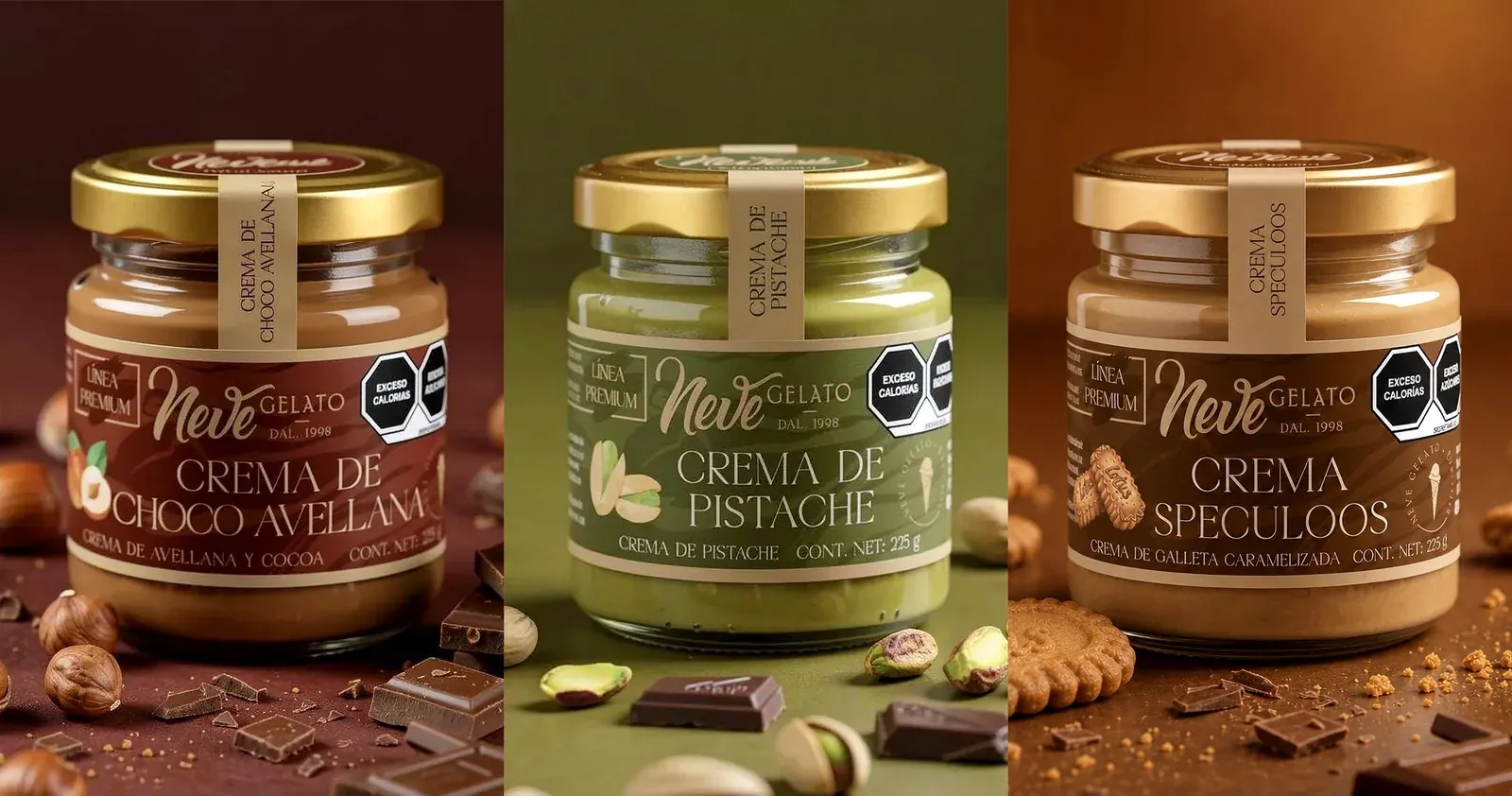
What stays
- Your brand: logo, colors, illustration and the way your customer recognizes you.
- Your product and your formula, unless an ingredient blocks a listing with a retailer.
- Spanish on the pack if you want it, with one condition: if the label carries any Spanish text, all required information must also appear in Spanish (21 CFR 101.15).
What goes
- The NOM-051 front of pack warning seals (such as EXCESO CALORÍAS or EXCESO SODIO) and their legends are a Mexican requirement. Reference: NOM-051 manual (Gobierno de México). On a US label, the required information is FDA's.
- The Mexican nutrition table format. In the US the format is Nutrition Facts.
What FDA requires
- Statement of identity and net quantity on the principal display panel. Net quantity goes in both metric and US customary units (21 CFR 101.105).
- Nutrition Facts (21 CFR 101.9), with serving sizes based on FDA reference amounts (21 CFR 101.12). That is why your lab values are recalculated to the US serving size, not copied from the Mexican table.
- Ingredient list in descending order by weight.
- Allergen statement for the major food allergens: milk, eggs, fish, crustacean shellfish, tree nuts, peanuts, wheat, soybeans and sesame. See Food Allergies (FDA).
- Name and place of business of the manufacturer, packer or distributor.
- Required information in English.
Full FDA guide: Food Labeling Guide.
Country of origin
An imported product must be marked with its country of origin for the ultimate purchaser in the US, for example "Product of Mexico". The rule comes from customs: 19 CFR Part 134 (eCFR).
A label can be legal and still fail the retailer
Retail chains apply ingredient lists on top of the law. Artificial colors are a common block in US retail. Check the label against the retailer's list before it goes to print. See why US retailers reject imported food products.
How FISA does it
- You send your current label, your lab nutrition analysis and your retailer's ingredient list if you have one.
- We redesign the label to FDA format inside your brand's design.
- We review it against federal rules and your retailer's ingredient standards.
- You receive print-ready files.
If you also need someone to import and sell your brand, FISA acts as importer of record on the programs it distributes, reviews label and ingredients, reformulates when an ingredient blocks a listing, warehouses in Texas and sells into retail and foodservice in Texas, Southern California, Arizona, Illinois and Utah. See US distribution for international food brands.
Nutrition values come from your lab analysis; we design them, we do not invent them. A compliant label does not guarantee a listing.
FAQ
Can I keep the NOM-051 seals on the label that goes to the US?
The seals are a Mexican requirement. If the same pack sells in both countries, the design has to solve both rules at once; if it is for the US only, the required information is FDA's. We look at it with your actual pack.
Can I copy the values from my Mexican nutrition table into Nutrition Facts?
Not directly. Nutrition Facts uses serving sizes based on FDA reference amounts (21 CFR 101.12), so the values from your lab analysis are recalculated to that serving.
Does my label have to be in English?
The required information does. You can keep Spanish, but if the label carries any Spanish text, all required information must also appear in Spanish (21 CFR 101.15).
What about allergens?
FDA requires declaring the major food allergens: milk, eggs, fish, crustacean shellfish, tree nuts, peanuts, wheat, soybeans and sesame.
Do you also import the product?
On the programs it distributes, FISA acts as importer of record, reviews label and ingredients, warehouses in Texas and sells into retail and foodservice in Texas, Southern California, Arizona, Illinois and Utah.
Is your label ready for the US?
Send your current label and your lab analysis, and we tell you what changes for the US market.